
ISO 704 — Terminology Work: Principles and Methods
What this standard is
ISO 704 establishes the principles and methods of terminology work. It is the foundational theoretical document — it defines what a concept is, how concepts form systems, and how terms are created for them. First published in 1987 and revised in 2000 and 2024, ISO 704 provides the intellectual framework upon which all other terminology standards (10241-1, 30042, 12620, 25964) build.
The standard covers:
- Concept theory — what constitutes a concept and how concepts differ from terms
- Characteristics — the individual features that distinguish one concept from another
- Concept systems — how concepts form hierarchical and associative networks
- The concept-term interaction cycle — the workflow for establishing terminology
- Definition writing — principles for writing clear, complete definitions
- Term formation — methods for creating new terms (neology)
Key concept: the concept–term distinction
ISO 704’s most fundamental principle is that a concept and a term are different things. A concept is a unit of thought (an abstraction of reality); a term is the linguistic sign that designates it. One concept can be expressed by many terms across many languages — but it remains one concept.
This is the core principle reflected in the Glossarist logo: 文 and ΓΛ merge into one mark because one concept is expressed across many scripts.
How Glossarist implements it
The concept–term separation
Glossarist implements the ISO 704 concept–term distinction directly in its two-tier model:
| ISO 704 concept | Glossarist entity |
|---|---|
| Concept (unit of thought) | ManagedConcept — language-independent identity |
| Term (linguistic sign) | LocalizedConcept → terms[] — per-language designations |
A ManagedConcept holds the stable identity (UUID, status, domains, cross-language relationships). Each LocalizedConcept is one language’s expression of that concept — with its own designations, definitions, notes, and examples.
Concept systems
ISO 704 defines two main types of concept systems:
- Hierarchical — concepts are organized by genus-species (generic), part-whole (partitive), or instance-of (instantial) relationships
- Associative — concepts are linked by thematic, causal, or temporal associations without a hierarchy
Glossarist implements both through the 27-type relationship system:
| ISO 704 system type | Glossarist relationship types |
|---|---|
| Generic hierarchy | broader, narrower, broader_generic, narrower_generic |
| Partitive hierarchy | broader_partitive, narrower_partitive |
| Instantial hierarchy | broader_instantial, narrower_instantial |
| Associative | see, related_concept, sequentially_related_concept, spatially_related_concept, temporally_related_concept |
Characteristics and domains
ISO 704 defines characteristics as the features that distinguish concepts within a system. In Glossarist, characteristics are expressed through:
domainson ManagedConcept — language-agnostic classification tags that place a concept within a subject fielddefinitionon LocalizedConcept — the intensional definition that lists the distinguishing characteristics
The concept-term interaction cycle
ISO 704 describes a cyclic workflow for terminology work — the continuous process of identifying concepts, positioning them in the system, writing definitions, and establishing terms:
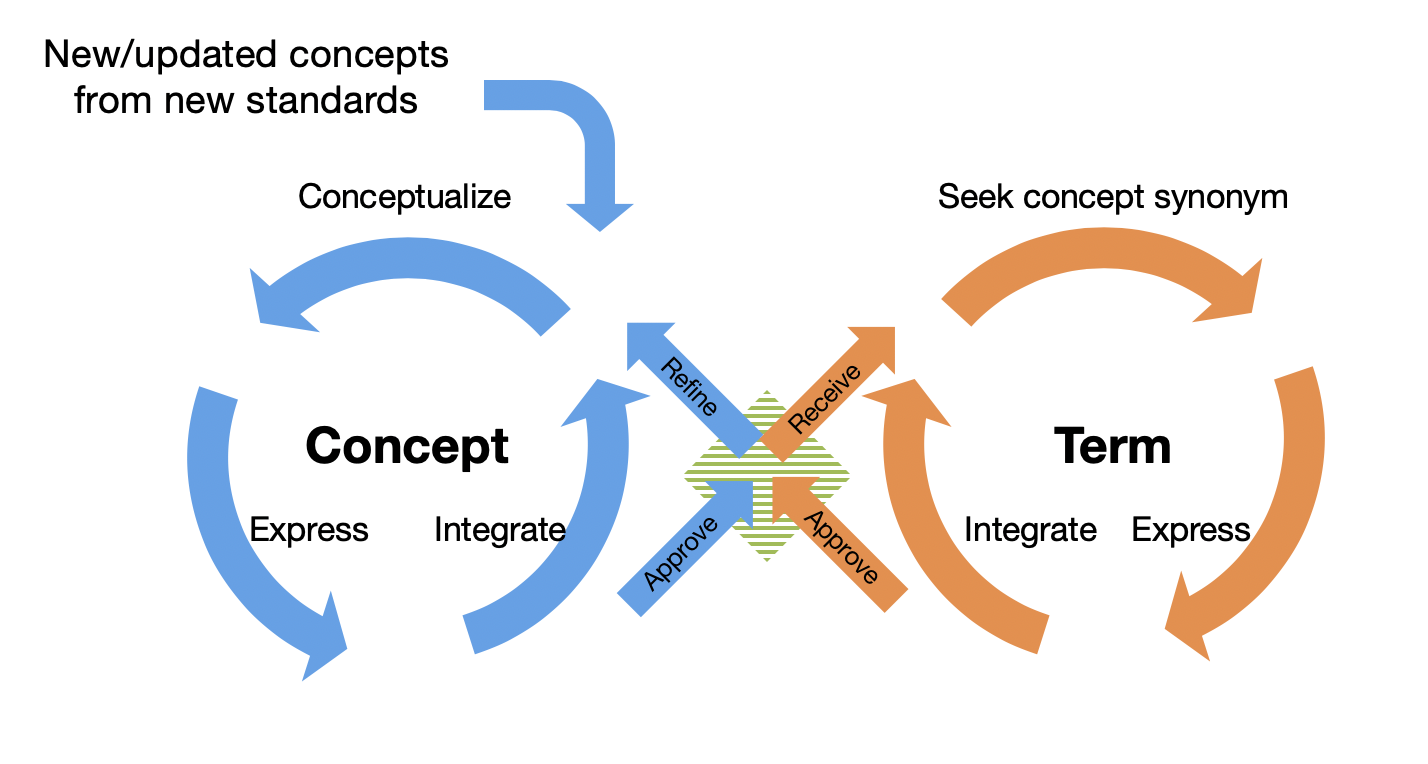
Glossarist’s Desktop App implements this cycle through its change request workflow: create a concept, define it, relate it to others, assign designations, submit for review, and publish.
Definition writing principles
ISO 704 requires definitions to be:
- Intensional — state the genus and the differentiating characteristics
- Not circular — the term being defined must not appear in its own definition
- Not negative — unless the concept is inherently negative
Glossarist’s DetailedDefinition type supports these principles with text content and per-definition sources that document where the definition originated.
Related
- ISO 10241-1 — Terminology Entries — the presentation standard that applies these principles
- ISO 25964 — Thesauri — extends the hierarchical model for thesaurus interoperability
- Concept Model: Concepts — ManagedConcept and LocalizedConcept
- Concept Model: Relationships — the 27-type relationship system
- Concept Model: Datasets & Sections — domain classification
- Standards Compliance Overview