
ISO 30042 — TBX: Terminology Markup Framework
What this standard is
ISO 30042 defines TBX (TermBase eXchange), the XML-based markup framework for representing and exchanging terminology data. Published in 2008 (revision in 2019), TBX ensures that terminology entries can move between different terminology management systems — translation tools, termbases, glossary editors — without loss of information.
The standard defines:
- TBX-Core — the minimal structural elements every TBX file must have
- TBX dialects — specialized profiles for specific industries (TBX-Basic, TBX-Min, TBX-Default, TBX-xCS)
- Data category categories — the vocabulary of fields and values that describe terms
- XCS files (eXtensible Constraint Specification) — machine-readable declarations of which data categories a specific TBX file uses
Key concept: the three-level structure
TBX organizes terminology data in a three-level hierarchy:
<termEntry>— the concept level (one entry per concept)<langSet>— the language level (one set per language)<tig>/<ntig>— the term level (one group per designation)
This mirrors the ISO 704 principle: one concept, many languages, many terms within each language.
How Glossarist implements it
GCR as TBX exchange medium
Glossarist’s native serialization format is YAML (human-readable, git-friendly). For TBX interchange, the glossarist-ruby gem provides bidirectional conversion between GCR (Glossarist Concept Representation) packages and TBX-XML.
The conversion path:
GCR YAML files ←→ glossarist-ruby ←→ TBX-XMLDesignation type hierarchy
TBX inherits its designation type system from ISO 12620. Glossarist implements the full MECE (Mutually Exclusive, Collectively Exhaustive) hierarchy:
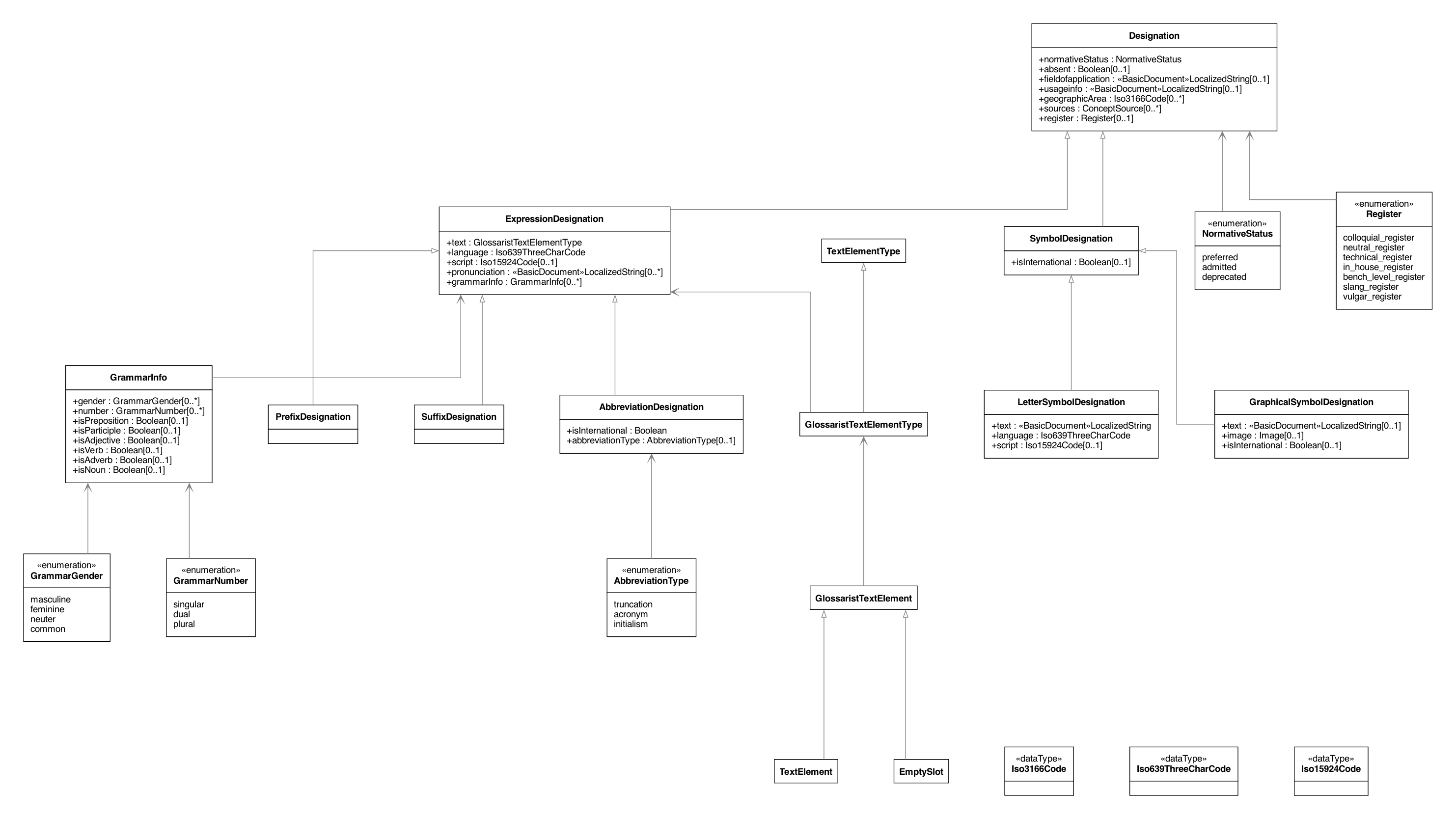
Term types
ISO 30042 / TBX defines a set of term type classifications (drawn from ISO 12620). Glossarist implements all of them as the term_type field on designations:
| Category | Term type values |
|---|---|
| Orthographic / structural | full_form, abbreviation, acronym, initialism, clipped_term, short_form, transliterated_form, transcribed_form, variant |
| Symbolic / formulaic | symbol, formula, equation, logical_expression |
| Usage / provenance | common_name, entry_term, internationalism, international_scientific_term, part_number, phraseological_unit, shortcut, sku, standard_text, synonym, synonymous_phrase |
See Term Types for the full list with examples.
Grammatical information
TBX encodes grammatical metadata (part of speech, gender, number). Glossarist implements these via grammar_info on expression designations:
| TBX data category | Glossarist field | Values |
|---|---|---|
| Part of speech | grammar_info.part_of_speech | noun, verb, adjective, adverb, preposition, participle, other |
| Grammatical gender | grammar_info.gender | masculine, feminine, neuter, common |
| Grammatical number | grammar_info.number | singular, dual, plural |
Designation-level relationships
TBX supports term-level cross-references for abbreviated and short forms. Glossarist implements these as designation-level related fields:
| TBX relationship | Glossarist type | Usage |
|---|---|---|
| Abbreviated form reference | abbreviated_form_for | Links an abbreviation back to its full form |
| Short form reference | short_form_for | Links a short form back to its full form |
Language and script identification
TBX uses RFC 3066 / IETF language tags for the xml:lang attribute. Glossarist decomposes this into three ISO-standardized code systems:
| Code system | Standard | Examples |
|---|---|---|
| Language | ISO 639 | eng, fra, deu, jpn, ara, rus, zho |
| Script | ISO 15924 | Latn, Arab, Cyrl, Hani, Kana |
| Conversion system | ISO 24229 | Hepburn, IPA, UN:rus-Cyrl:Latn:1993 |
This decomposition allows Glossarist to represent multi-script entries — e.g., a Japanese concept with Kanji, Kana, and Romaji variants — which map cleanly to TBX langSet elements with different xml:lang values.
Normative status mapping
TBX uses the normativeStatusCode attribute on term elements. Glossarist maps these directly:
| TBX status | Glossarist normative_status | Meaning |
|---|---|---|
preferred | preferred | The preferred term for this concept in this language |
admitted | admitted | A synonym accepted alongside the preferred term |
notRecommended | deprecated | A term that should not be used in new work |
superseded | superseded | A term replaced by a newer preferred term |
TBX export
To export a GCR package as TBX:
# Using glossarist-ruby
glossarist convert --input concepts/ --output glossary.tbx --format tbx
The exported TBX file can then be imported into any TBX-compatible tool (SDL Trados, memoQ, Termium, etc.).
Related
- ISO 12620 — Data Categories — the data category registry that defines TBX’s vocabulary
- ISO 10241-1 — Terminology Entries — the entry structure TBX encodes
- Concept Model: Designations — the five designation types
- Concept Model: Term Types — all 24 term type values
- Glossarist Ruby — TBX conversion via the
tbxgem - Standards Compliance Overview