
ISO 12620 — Data Category Registry
What this standard is
ISO 12620 provides a data category registry — a controlled, standardized vocabulary of metadata fields and values used to describe terminology data. Published in 2009, it is the reference dictionary that TBX (ISO 30042) draws from to populate its elements and attributes.
The standard defines:
- Data categories — named fields for terminology metadata (e.g.,
partOfSpeech,grammaticalGender,termType) - Value lists — the allowed values for each data category (e.g.,
noun,verb,adjectiveforpartOfSpeech) - Open vs. closed value sets — some categories allow user-defined extensions, others are fixed
- DatCatInfo declarations — machine-readable descriptions of each data category
Key concept: data categories vs. free text
Without ISO 12620, every terminology system invents its own field names and value vocabularies. System A calls it “Part of Speech”; System B calls it “Grammar”; System C calls it “POS” — and their value lists differ too. ISO 12620 eliminates this ambiguity by providing a single, normative registry that everyone references.
How Glossarist implements it
Term type classification
The most prominent ISO 12620 contribution to Glossarist is the term type vocabulary. Every designation in Glossarist can carry a term_type field whose value must come from the ISO 12620 / TBX registry. The classification applies across all seven designation types:
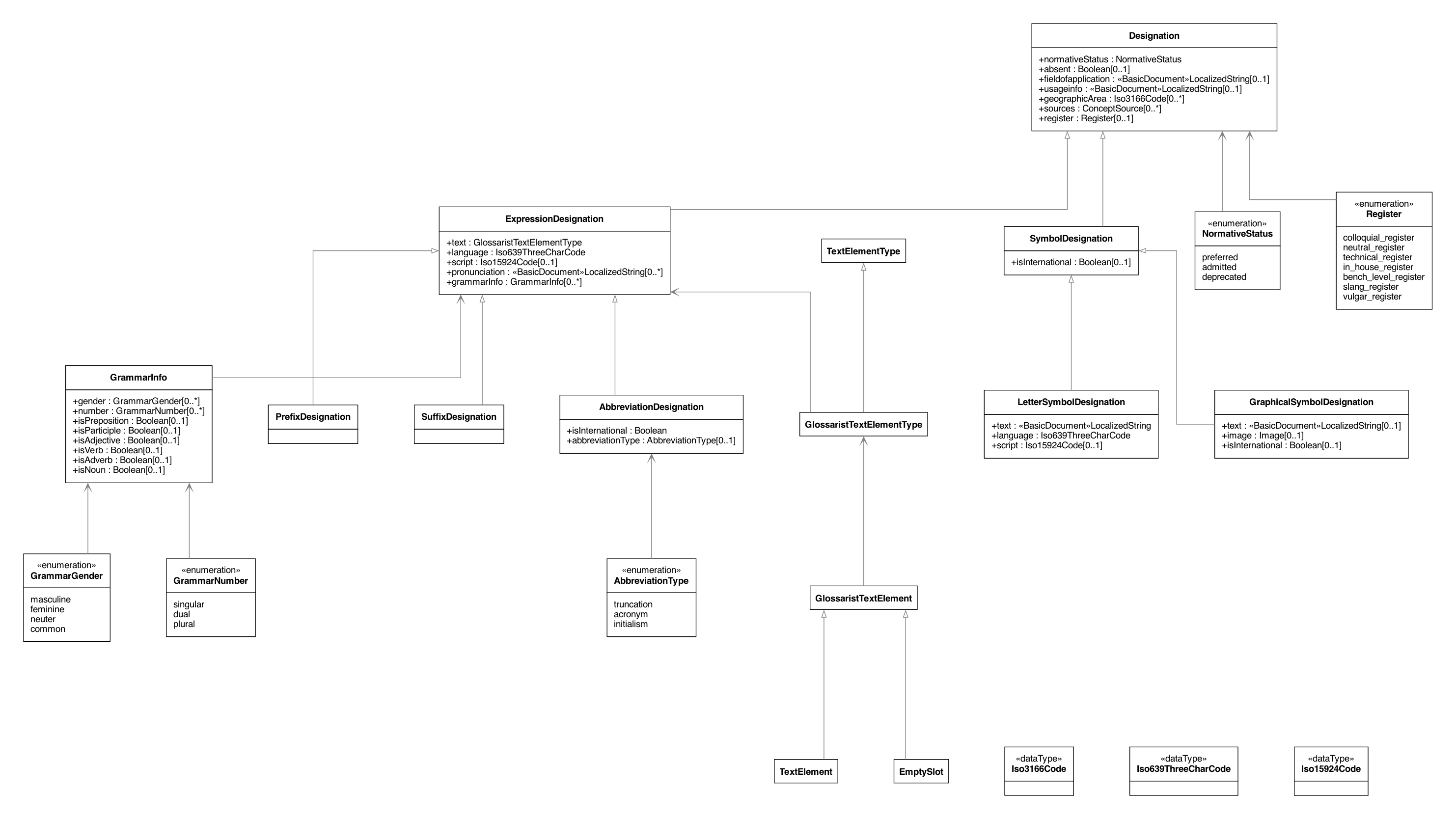
term_type field, which classifies each designation using the ISO 12620 data category registry.| Category | Term type values |
|---|---|
| Orthographic / structural | full_form, abbreviation, acronym, initialism, clipped_term, short_form, transliterated_form, transcribed_form, truncation, variant |
| Symbolic / formulaic | symbol, formula, equation, logical_expression, mathematical_expression, reference_symbol, figure_symbol, graphic_symbol, letter_symbol, roman_numeral |
| Usage / provenance | code, common_name, entry_term, internationalism, international_scientific_term, part_number, phrase, phraseological_unit, scientific_name, shortcut, sku, standard_text, synonym, synonymous_phrase |
See Term Types for the full taxonomy with definitions.
Part of speech
ISO 12620 defines a closed list of parts of speech. Glossarist implements this via grammar_info.part_of_speech:
| ISO 12620 value | Glossarist value |
|---|---|
noun | noun |
verb | verb |
adjective | adjective |
adverb | adverb |
preposition | preposition |
participle | participle |
other | other |
Grammatical number
| ISO 12620 value | Glossarist value |
|---|---|
singular | singular |
dual | dual |
plural | plural |
Grammatical gender
| ISO 12620 value | Glossarist value |
|---|---|
masculine | masculine |
feminine | feminine |
neuter | neuter |
common | common (for languages that combine m/f) |
Source status
ISO 12620 / TBX defines how a source relates to the entry it documents. Glossarist implements these as the ConceptSource.status field. Each describes how the entry’s content relates to the cited source:
| Status | Meaning |
|---|---|
identical | Content is identical to what appears in the source |
modified | Content has been modified from the source |
restyled | Content has been restyled (formatting changes only) |
context_added | Additional context has been added to the source content |
generalisation | Content is a generalisation of the source content |
specialisation | Content is a specialisation of the source content |
unspecified | The relationship to the source is unspecified |
similar | Content is similar but not identical to the source |
related | Content is related to the source but not derived from it |
not_equal | Content explicitly differs from the source |
The optional modification field on each ConceptSource provides a free-text description of what changed relative to the original.
Lexical relationships
ISO 12620 / TBX defines two lexical relationship types that are language-specific:
homograph— same spelling, different meaning (intra-language)false_friend— similar spelling across languages but different meaning (cross-language)
These are implemented in Glossarist at the LocalizedConcept level because they only exist within or between specific languages — a concept that is a false friend in French may not be one in German.
Related
- ISO 30042 — TBX Format — the markup framework that uses these data categories
- ISO 10241-1 — Terminology Entries — the entry structure these fields populate
- Concept Model: Term Types — all 24 term type values with examples
- Concept Model: Sources — source status and provenance tracking
- Concept Model: Relationships — homograph and false friend relationships
- Standards Compliance Overview