
ISO 10241-1 — Terminology Entries in Standards
What this standard is
ISO 10241-1 defines the general requirements for terminological entries in standardized vocabularies and gives examples of how they should be presented. Published in 2011, it is the presentation-layer companion to ISO 704 (which defines the principles) — together they specify what a well-formed terminology entry looks like when it appears in an official standard or glossary.
The standard covers:
- The structure of a terminological entry (concept → designations → definition → notes → examples → sources)
- Required, recommended, and optional fields
- Presentation rules for terms, definitions, and cross-references
- How to handle non-verbal representations (images, tables, formulas)
- Designation-level relationships (abbreviations, short forms, variants)
- Comparative and associative relationships between concepts
Key concept: the “terminological entry”
An ISO 10241-1 entry is not a dictionary definition. It is a structured record whose purpose is to establish a concept unambiguously and document every way the concept is referred to, defined, sourced, and related to other concepts.
How Glossarist implements it
Glossarist’s concept model is built directly on the ISO 10241-1 entry structure. Every ManagedConcept in Glossarist corresponds to one terminological entry.
Entry structure
Glossarist’s two-tier concept model — a language-independent ManagedConcept holding multiple per-language LocalizedConcept instances — is the direct implementation of the ISO 10241-1 entry structure:
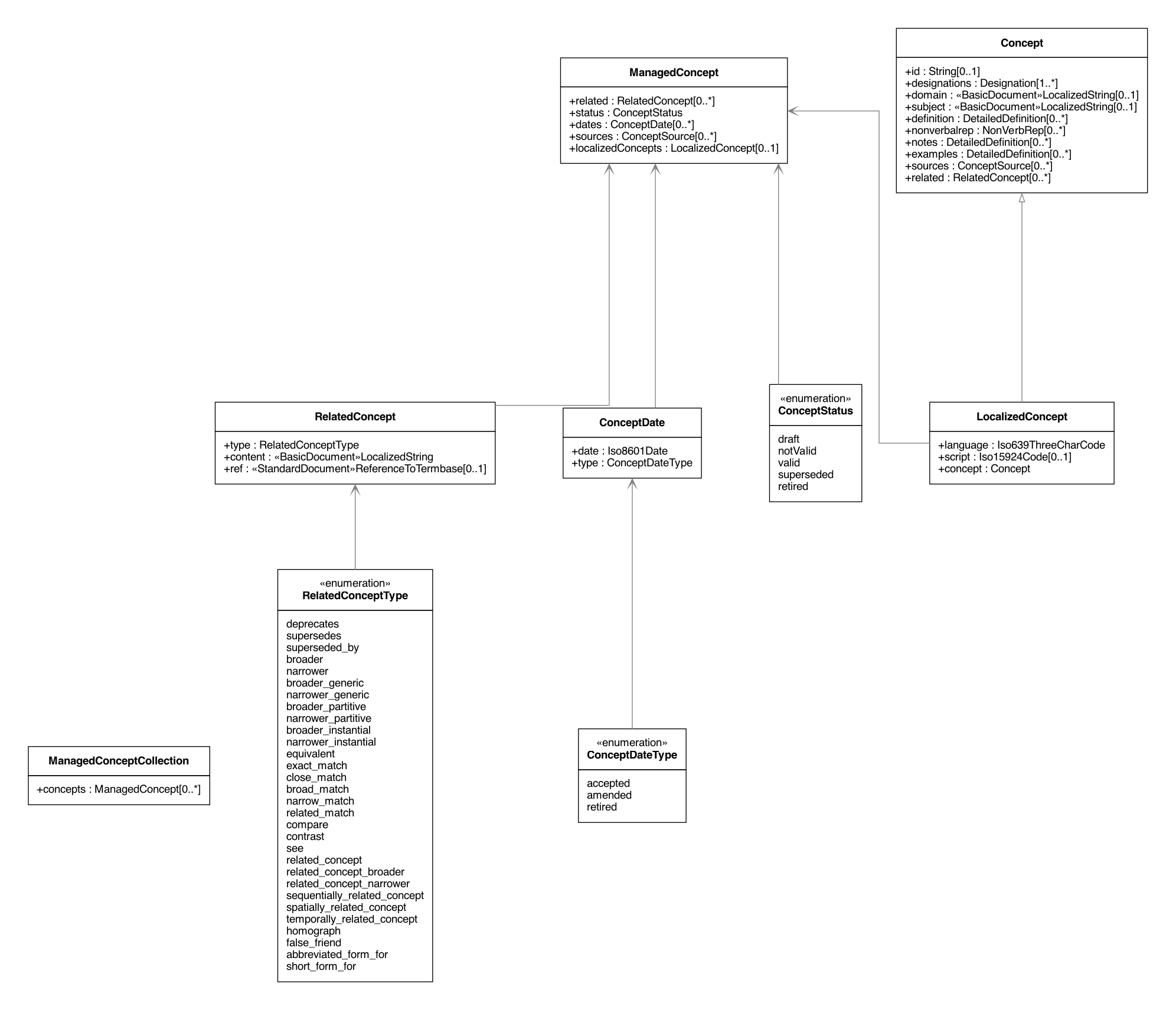
| ISO 10241-1 section | Glossarist entity | Field |
|---|---|---|
| Concept identifier | ManagedConcept | id, identifier, data.uri |
| Designations (terms) | LocalizedConcept → terms[] | designation, normative_status, type |
| Definition | LocalizedConcept | definition (DetailedDefinition) |
| Notes | LocalizedConcept | notes[] |
| Examples | LocalizedConcept | examples[] |
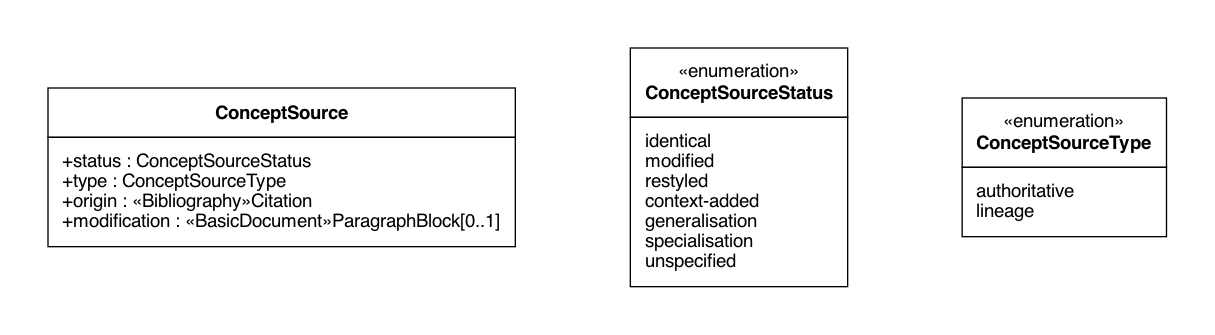
| Sources | ConceptSource | type, status, origin, modification |
| Non-verbal reps | LocalizedConcept | non_verbal_rep |
| Relationships | ConceptRelation | type, content |
Designation-level relationships (§5.4.2)
ISO 10241-1 §5.4.2 defines relationships at the designation level — links between individual terms rather than concepts. Glossarist implements these via the DesignationRelationship type:
abbreviated_form_for— links an abbreviation to its full formshort_form_for— links a short form to its full form
Concept-level relationships
| ISO 10241-1 type | Glossarist type |
|---|---|
| Equivalence | equivalent |
| Comparative | compare, contrast |
| Associative | see |
| Lifecycle | deprecates, supersedes, superseded_by |
Sources and provenance
ISO 10241-1 requires that every definition, note, and example document its authoritative source. Glossarist implements this as a multi-level source system — sources can appear on the managed concept, localized concept, individual definition/note/example, and individual designation:
Non-verbal representations (§6.5)
ISO 10241-1 §6.5 specifies that entries may reference non-verbal material (images, tables, formulas) by URI. Glossarist’s non_verbal_rep field implements this with support for relative paths, URNs, and URLs.
Normative status
ISO 10241-1 defines preferred, admitted, deprecated, and superseded designations. Glossarist implements these as the normative_status enum on every designation:
| ISO 10241-1 status | Glossarist normative_status |
|---|---|
| Preferred term | preferred |
| Admitted term | admitted |
| Deprecated term | deprecated |
| Superseded term | superseded |
Related
- ISO 704 — Principles & Methods — the theory behind the entry structure
- ISO 30042 — TBX Format — machine-readable exchange format for entries
- Concept Model: Concepts — ManagedConcept and LocalizedConcept
- Concept Model: Designations — the five designation types
- Concept Model: Sources — authoritative and lineage sources
- Standards Compliance Overview