
ISO 25964 — Thesauri and Interoperability with SKOS
What this standard is
ISO 25964 defines thesaurus structure and interoperability for information retrieval. Published in two parts (Part 1: Thesauri for Information Retrieval, 2011; Part 2: Interoperability with other vocabularies, 2013), it is the standard that governs how controlled vocabularies organize concepts for search, indexing, and cross-vocabulary mapping.
The standard defines:
- Hierarchical relationships — broader/narrower term (BT/NT) with three subtypes
- Associative relationships — related term (RT) and its specialized forms
- Equivalence relationships — preferred term (USE) and used-for (UF)
- Mapping relationships — cross-vocabulary alignment (exact, close, broad, narrow, related match)
- Concept scheme structure — how concepts are grouped into thesauri
Key concept: the three hierarchical subtypes
ISO 25964 refines the simple broader/narrower relationship into three subtypes — a crucial distinction that most thesaurus implementations miss:
- Generic (BTG/NTG) — genus–species: “mammal” BTG “dog”
- Partitive (BTP/NTP) — whole–part: “car” BTP “wheel”
- Instantial (BTI/NTI) — class–instance: “planet” BTI “Earth”
This refinement is essential for precise terminology work — the relationship between “car” and “wheel” is fundamentally different from the relationship between “vehicle” and “car”.
How Glossarist implements it
SKOS concept schemes
ISO 25964 Part 2 aligns with SKOS (the W3C Simple Knowledge Organization System). Glossarist implements 14 SKOS concept schemes, defined as taxonomy TTL files in the concept-model repository:
- Concept groups (dataset-level organization)
- Concept schemes (vocabulary-level grouping)
- Mapping relationships (cross-vocabulary alignment)
Hierarchical relationships
The concept hierarchy in Glossarist implements the full ISO 25964 three-subtype model:
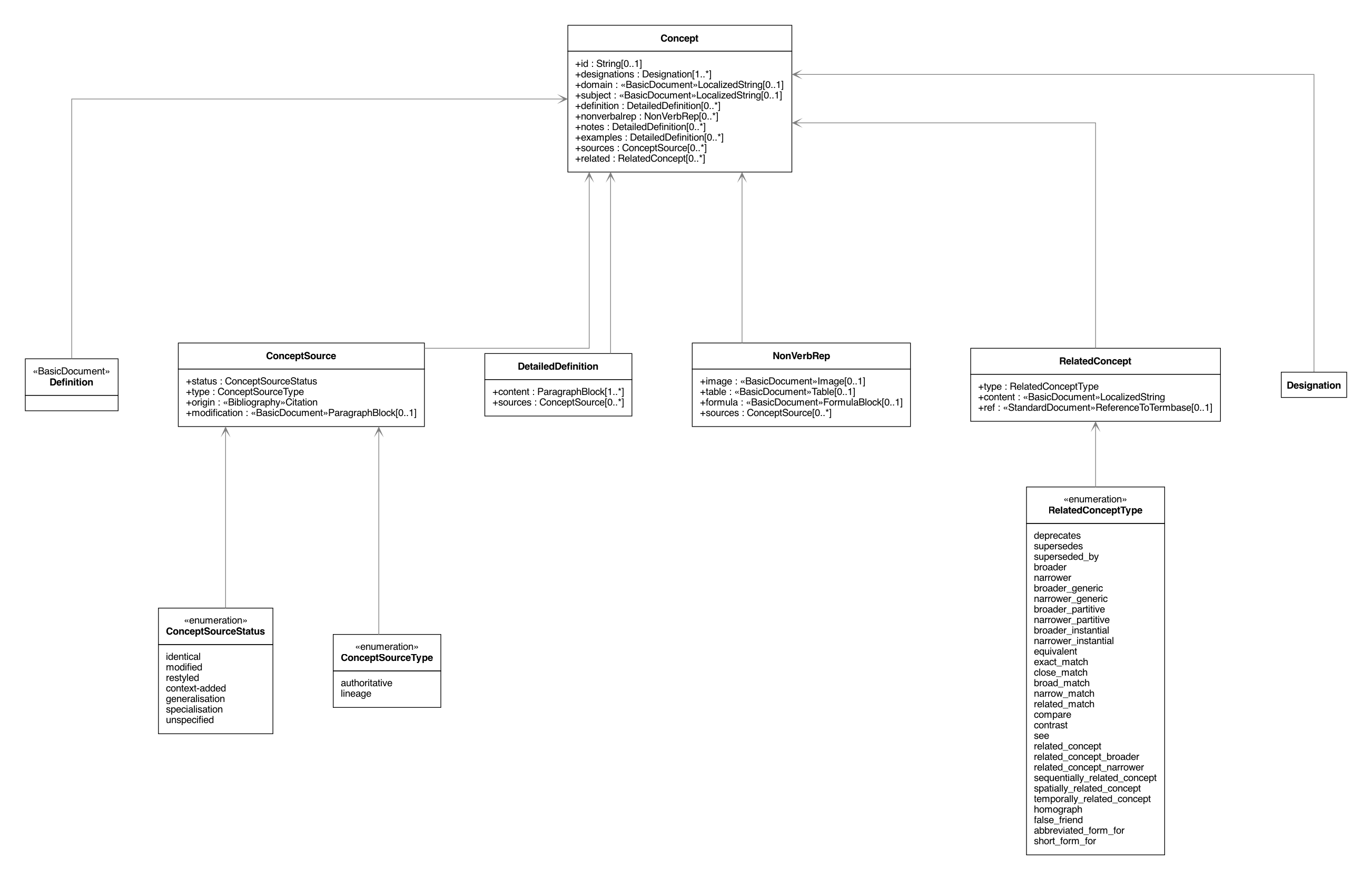
Glossarist implements all three ISO 25964 hierarchical subtypes:
| ISO 25964 | Glossarist type | Direction |
|---|---|---|
| BT (broader term) | broader | concept → parent |
| NT (narrower term) | narrower | concept → child |
| BTG (broader generic) | broader_generic | genus direction |
| NTG (narrower generic) | narrower_generic | species direction |
| BTP (broader partitive) | broader_partitive | whole direction |
| NTP (narrower partitive) | narrower_partitive | part direction |
| BTI (broader instantial) | broader_instantial | class direction |
| NTI (narrower instantial) | narrower_instantial | instance direction |
Mapping relationships
ISO 25964 / SKOS defines five mapping types for aligning concepts across different vocabularies:
| SKOS property | Glossarist type | Meaning |
|---|---|---|
skos:exactMatch | equivalent | Concepts are exactly equivalent |
skos:closeMatch | close_match | Concepts are approximately equivalent |
skos:broadMatch | broad_match | Target concept is broader |
skos:narrowMatch | narrow_match | Target concept is narrower |
skos:relatedMatch | related_match | Target concept is related (not hierarchical) |
These mappings enable interoperability between Glossarist-managed registries and external vocabularies (e.g., mapping an ISO/TC 211 concept to a corresponding INSPIRE concept).
Full relationship type coverage
Glossarist implements 52 typed semantic relationship types spanning five standards. The ISO 25964 contribution is the hierarchical and associative system:
| Category | Standard | Types |
|---|---|---|
| Hierarchical — generic | ISO 25964 / SKOS | broader, narrower, broader_generic, narrower_generic |
| Hierarchical — partitive | ISO 25964 / ISO 19135 | broader_partitive, narrower_partitive, has_part, is_part_of |
| Hierarchical — instantial | ISO 25964 / ISO 19135 | broader_instantial, narrower_instantial, instance_of, has_instance |
| Equivalence | ISO 10241-1 / SKOS | equivalent |
| SKOS mapping | SKOS | close_match, broad_match, narrow_match, related_match |
| Associative | ISO 10241-1 / ISO 25964 | see, references, related_concept, related_concept_broader, related_concept_narrower |
| Spatiotemporal | ISO 25964 / TBX | sequentially_related_concept, spatially_related_concept, temporally_related_concept |
| Lifecycle | ISO 10241-1 / ISO 19135 | deprecates, deprecated_by, supersedes, superseded_by, replaces, replaced_by, invalidates, invalidated_by, retires, retired_by |
| Lexical | ISO 12620 / TBX | homograph, false_friend |
| Comparative | ISO 10241-1 | compare, contrast |
| Designation-level | ISO 10241-1 | abbreviated_form_for, short_form_for |
Cross-dataset navigation
Relationships can link concepts across datasets using URN-based references. Each dataset declares a urn (e.g., urn:oiml:pub:v:1:2022 for VIML 2022) in its register.yaml. Cross-dataset relationships reference the target by URN and concept identifier, enabling federated concept systems that span multiple registries.
Inverse edge derivation
Many relationship types are directional — broader in one direction implies narrower in the reverse. The concept-browser derives these inverse edges automatically, so a relationship need only be declared in one direction.
SKOS / RDF export
Glossarist exports concepts as SKOS/RDF via glossarist-ruby:
# Export a GCR package as SKOS Turtle
glossarist convert --input concepts/ --output glossary.ttl --format ttl
The exported RDF file uses standard SKOS properties (skos:Concept, skos:broader, skos:exactMatch, etc.) and can be loaded into any RDF triplestore or SPARQL endpoint.
Related
- ISO 704 — Principles & Methods — the concept theory that underpins hierarchical relationships
- ISO 10241-1 — Terminology Entries — the entry structure for equivalence and associative links
- Concept Model: Relationships — the full 27-type relationship system
- Ontology Browser — explore the concept hierarchy interactively
- Glossarist Ruby — SKOS/RDF export
- Standards Compliance Overview