
Sequential Relations
A SequentialHyperedge implements ISO 12620 A.6.3 sequential relations and ISO 704:2022 §5.5.5 Table 1’s sequential relation subtypes. It connects a comprehensive concept (the start or whole) to two or more subordinate concepts in an ordered sequence — temporal, spatial, causal, or developmental.
Sequential is the third n-ary hyperedge type, alongside Partitive and Generic. The structural difference: member array order is significant in sequential, whereas partitive and generic members are unordered sets.
How it looks
The frog life cycle is ISO 704:2022 §5.5.5’s canonical developmental subtype. Five stages flow in temporal order, each with its delimiting characteristic:
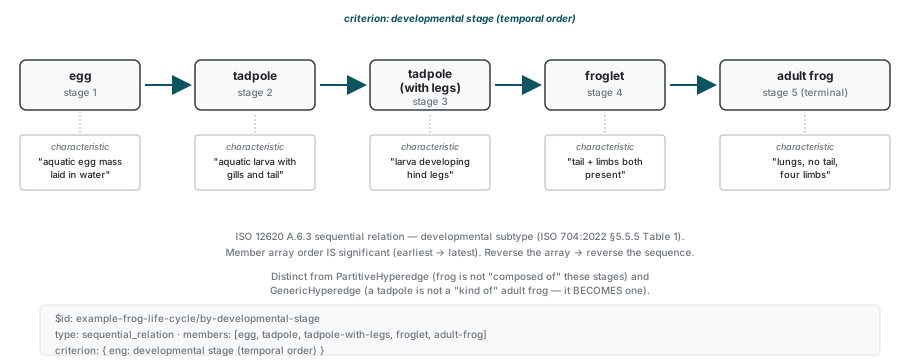
Arrows (not rake teeth) indicate order. Reversing the array reverses the sequence — a property Partitive and Generic don’t have.
When to use SequentialHyperedge vs. alternatives
| Shape | Use when … |
|---|---|
Binary sequentially_related_concept / spatially_related_concept / temporally_related_concept | Pairwise assertion with no completeness or multidimensionality claim |
PartitiveHyperedge | Whole is composed of parts (simultaneous) — a frog is not “composed of” its life stages |
GenericHyperedge | Species share a genus — a tadpole is not a “kind of” adult frog, it becomes one |
SequentialHyperedge | Steps in an ordered process; earlier → later; cause → effect; stage → stage |
ISO 704:2022 §5.5.5 Table 1 enumerates the major sequential subtypes:
| Subtype | Example |
|---|---|
| temporal relation (earlier–later) | production → consumption |
| causal relation (cause–effect) | humidity → corrosion |
| spatial relation (position in space) | floor → ceiling |
| developmental relation (process step – process step) | tadpole → frog |
Multidimensionality (ISO 704:2022 §5.6.3)
A single comprehensive can have multiple sequential rakes distinguished by criterion — same multidimensionality principle as Partitive and Generic. For example, a manufacturing process can be decomposed by:
- process step (raw material → design → prototype → production → QC → packaging → distribution)
- organizational responsibility (engineering → operations → quality → logistics)
Each criterion is a distinct SequentialHyperedge file.
Model
SequentialHyperedge extends AbstractHyperedge
  +comprehensive: ConceptRef [1]              # start of the sequence
  +members:       SequentialMember [2..*]      # ORDERED — array order matters
  +completeness:  Completeness [0..1]         # complete | partial
  +criterion:     LocalizedString [0..1]      # sequencing criterion
  +sources:       ConceptSource [0..*]
  +notes:         LocalizedString [0..1]
  +status:        ConceptStatus [0..1]

SequentialMember extends HyperedgeMember
  # Inherits the shared MECE pair (ref, presence, count) from HyperedgeMember.
  # Adds NO additional fields — sequential members are distinguished by
  # their array position, not by a characteristic text or boolean flag.
  # This mirrors glossarist-js's SequentialMember implementation (Phase 1).
Wire format
# relations/example-frog-life-cycle/by-developmental-stage.yaml
$id: example-frog-life-cycle/by-developmental-stage
type: sequential_relation
status: valid
comprehensive:
  source: EXAMPLE
  id: "frog-life-cycle"
members:
  - ref: { source: EXAMPLE, id: "egg" }
  - ref: { source: EXAMPLE, id: "tadpole" }
  - ref: { source: EXAMPLE, id: "tadpole-with-legs" }
  - ref: { source: EXAMPLE, id: "froglet" }
  - ref: { source: EXAMPLE, id: "adult-frog" }
    characteristic: { eng: adult form with lungs, no tail, four limbs }
completeness: complete
criterion: { eng: developmental stage (temporal order) }
The member array order IS significant — earliest member first, latest last. Reverse the array → reverse the sequence. This is the structural difference from Partitive and Generic (whose members are unordered sets).
Validators
check-sequential-relation-coherence— same checks as partitive/generic coherence (cardinality, MECE combo, duplicate criterion), plus a sequential-specific check: warns when a member ref appears more than once in the same sequence (suggests the sequence is poorly defined).
See also
- Hyperedges — unified model page covering all three types
- Partitive Relations — whole/part
- Generic Relations — genus/species
- Relationships — binary typed edges
- ISO 12620 A.6.3 — sequential relation
- ISO 704:2022 §5.5.5 Table 1 — associative relation subtypes