
Partitive Relations
PartitiveHyperedge is the partitive specialization of Hyperedge — one comprehensive concept (the whole) decomposed into two or more partitive concepts (the parts) which fitted together constitute the comprehensive. Implements ISO 704:2022 §5.5.4.3.
This page covers what’s unique to partitive rakes. The shared model — MECE member multiplicity, criterion of subdivision, per-file storage, ExternalConcept as comprehensive — lives on the Hyperedges page.
ISO 704:2022 terminology
| Role | ISO term |
|---|---|
| The whole concept | comprehensive concept (superordinate concept partitive) |
| Each part concept | partitive concept (subordinate concept partitive) |
| The relation | partitive relation |
| Siblings in one rake | coordinate concepts |
All parts within one PartitiveHyperedge are coordinate concepts (ISO 12620): they share the comprehensive AND the criterion of subdivision.
Delimiting parts (ISO 704:2022 §5.5.4.2.2)
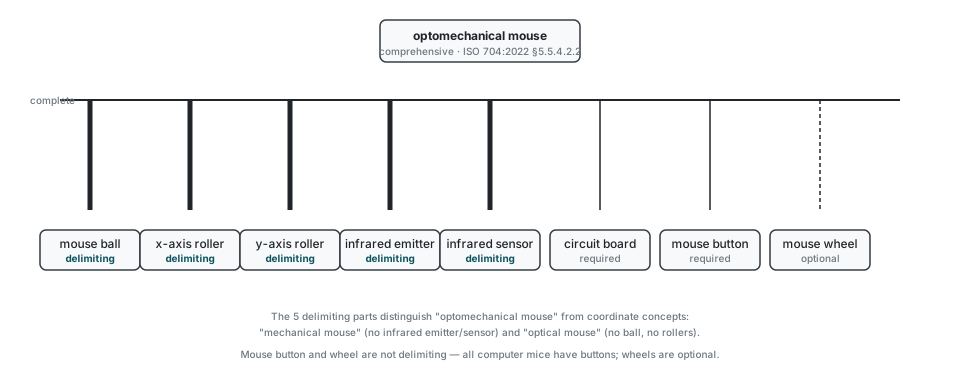
A delimiting part behaves like a delimiting characteristic: it distinguishes the comprehensive from coordinate concepts. In ISO 704 diagrams, delimiting parts are drawn with a bold (3x-width) line. The is_delimiting: true flag on a PartitiveMember encodes this — PartitiveMember is the only place this flag lives (it’s partitive-specific per ISO 704 §5.5.4.2.2; generic members carry delimitingCharacteristic text instead, see Generic Relations).
Delimiting is orthogonal to presence and count — a delimiting part can be compulsory, optional, or any other multiplicity. See the MECE multiplicity table on the Hyperedges page.
Canonical example (ISO 704:2022 §5.5.4.2.2): for “optomechanical mouse”:
| Part | Delimiting? | Why? |
|---|---|---|
| mouse ball | yes | distinguishes from optical mice |
| x-axis roller | yes | distinguishes from optical mice |
| y-axis roller | yes | distinguishes from optical mice |
| infrared emitter | yes | distinguishes from mechanical mice |
| infrared sensor | yes | distinguishes from mechanical mice |
| circuit board | no | all mice have circuit boards |
| mouse button | no | all computer mice have buttons |
| mouse wheel | no | not found on all optomechanical mice (optional) |
YAML authoring
Per-file layout: relations/<comprehensive-id>/<criterion-slug>.yaml (see Hyperedges — Per-file storage for the rationale).
# relations/viml-112-02-09/measurement-result-composition.yaml
$id: viml-112-02-09/measurement-result-composition
type: partitive_relation
status: valid
comprehensive:
  source: VIM
  id: "112-02-09"
members:
  - ref: { source: VIM, id: "112-02-10" }
  - ref: { source: VIM, id: "112-03-26" }
completeness: complete
criterion:
  eng: measurement result composition
Optomechanical mouse (ISO 704:2022 §5.5.4.2.2)
# relations/example-optomechanical-mouse/physical-component-decomposition.yaml
$id: example-optomechanical-mouse/physical-component-decomposition
type: partitive_relation
status: valid
comprehensive: { source: EXAMPLE, id: optomechanical-mouse }
members:
  - ref: { source: EXAMPLE, id: mouse-ball }
    is_delimiting: true
  - ref: { source: EXAMPLE, id: x-axis-roller }
    is_delimiting: true
  - ref: { source: EXAMPLE, id: y-axis-roller }
    is_delimiting: true
  - ref: { source: EXAMPLE, id: infrared-emitter }
    is_delimiting: true
  - ref: { source: EXAMPLE, id: infrared-sensor }
    is_delimiting: true
  - ref: { source: EXAMPLE, id: circuit-board }
  - ref: { source: EXAMPLE, id: mouse-button }
  - ref: { source: EXAMPLE, id: mouse-wheel }
    presence: optional
completeness: complete
criterion:
  eng: physical component decomposition
Mouse wheel has presence: optional (not found on all optomechanical mice). The five delimiting parts distinguish “optomechanical mouse” from coordinate concepts “mechanical mouse” and “optical mouse”.
Two decompositions of the same comprehensive
A comprehensive can carry multiple partitive hyperedges, each with its own criterion:
# relations/example-bicycle/by-physical-structure.yaml
$id: example-bicycle/by-physical-structure
type: partitive_relation
comprehensive: { source: EXAMPLE, id: bicycle }
members:
  - ref: { source: EXAMPLE, id: frame }
  - ref: { source: EXAMPLE, id: wheels }
completeness: complete
criterion: { eng: physical structure }

# relations/example-bicycle/by-functional-subsystem.yaml
$id: example-bicycle/by-functional-subsystem
type: partitive_relation
comprehensive: { source: EXAMPLE, id: bicycle }
members:
  - ref: { source: EXAMPLE, id: structural }
  - ref: { source: EXAMPLE, id: propulsion }
completeness: complete
criterion: { eng: functional subsystem }
The coherence validator rejects duplicate (comprehensive, criterion) pairs as errors.
RDF emission
<concept/optomechanical-mouse> gloss:hasPartitiveHyperedge [
  a gloss:PartitiveHyperedge ;
  gloss:comprehensive <concept/optomechanical-mouse> ;
  gloss:hasPartitive
    [ a gloss:PartitiveMember ; gloss:ref <concept/mouse-ball> ; gloss:isDelimiting true ] ,
    [ a gloss:PartitiveMember ; gloss:ref <concept/mouse-wheel> ; gloss:presence <partitivePresence/optional> ] ;
  gloss:completeness <completeness/complete> ;
  gloss:criterion "physical component decomposition"@en ;
] .
Validation
The check-partitive-relation-coherence validator enforces partitive-specific invariants:
- Cardinality: ≥ 2 partitive members per rake (ISO 704 “two or more”)
- No duplicate
(comprehensive, criterion)pairs - Invalid MECE combo (
optional + at_least_one) rejected - Warning on
is_delimiting: true+presence: optional— a delimiting part that’s optional is semantically incoherent
Shared validation rules (criterion-of-subdivision coherence, ExternalConcept-as-comprehensive, relation-file-shape) are listed under Hyperedges — Validators.
See also
- Hyperedges — abstract base model (shared MECE, per-file storage, ExternalConcept)
- Generic Relations — genus/species specialization
- Relationships — binary typed edges (
has_part,is_part_of, etc.) - Concepts — ManagedConcept, LocalizedConcept, ExternalConcept
- ISO 704:2022 §5.5.4.3 — partitive concept systems