
Hyperedges
A hyperedge is Glossarist’s model for ISO 704:2022 §5.5.4 n-ary concept relations — the rake or bracket diagrams that appear in terminology source materials when one comprehensive concept is decomposed into multiple coordinate concepts.
Glossarist supports two kinds:
| Type | ISO 704 § | Comprehensive means | Members are |
|---|---|---|---|
PartitiveHyperedge | §5.5.4.3 | the whole | parts that fitted together constitute the whole |
GenericHyperedge | §5.5.4.1 | the genus | species that share the genus |
Both share the same wire shape, the same MECE member dimensions, and the same validators. They differ only in semantic interpretation of comprehensive and members.
How they look
A hyperedge is drawn as a rake: a horizontal backline connects the comprehensive concept to multiple member concepts dropping down as teeth. ISO 704:2022 defines specific line notations for each tooth that encode per-member semantics.
Partitive hyperedge example
The VIM measurement result (2.9) decomposes into three parts. The diagram encodes multiplicity per part:
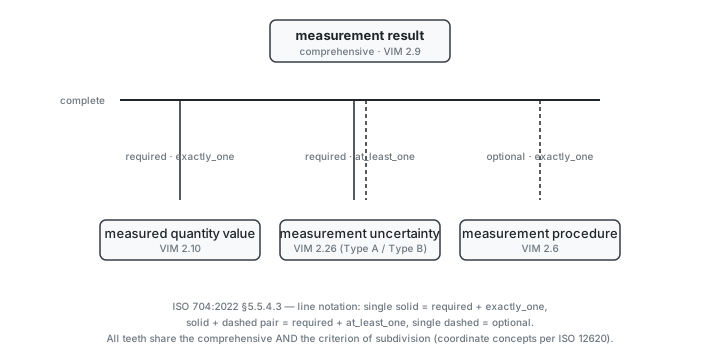
- Solid line = required (must exist in every instance)
- Dashed line = optional (exists in some instances only)
- Bold 3x-width line = delimiting (distinguishes the comprehensive from coordinate concepts)
- Joined backline = complete decomposition (all parts encoded)
Generalization hyperedge example
The OIML measurement standard (5.1) decomposes by multiple criteria. Each criterion is a distinct hyperedge on the same genus, and each species carries its delimiting characteristic in a side rectangle per ISO 704:2022 §5.5.4.2.1:
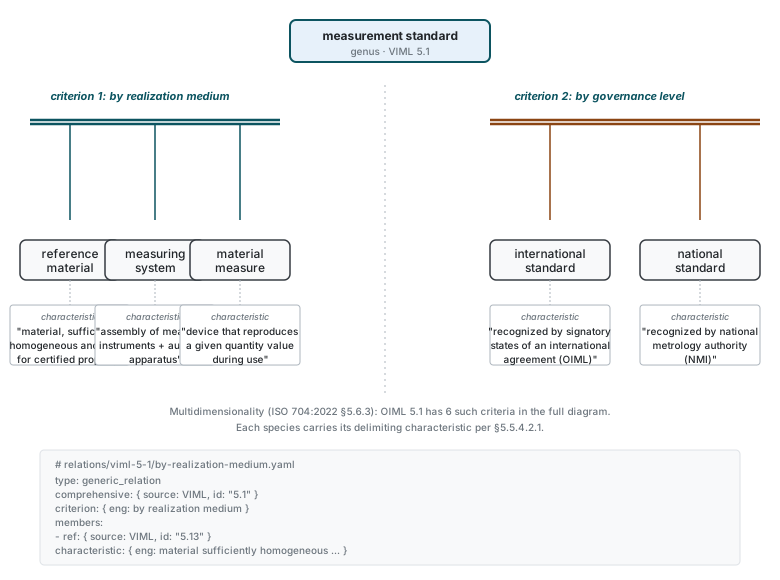
Two hyperedges, same comprehensive, different criteria. Species within one rake are coordinate concepts (share genus + share criterion). Species across rakes are NOT coordinate — they belong to different decompositions.
The canonical ISO 704:2022 §5.5.4.2.1 example — computer mouse (generic)
ISO 704:2022 §5.5.4.2.1 uses computer mouse as its canonical worked example for generic relations. The same genus is decomposed by two distinct criteria of subdivision (multidimensionality, §5.6.3): by means of movement detection (mechanical / optomechanical / optical) and by computer connection (wired / wireless). Each species carries a delimiting characteristic:
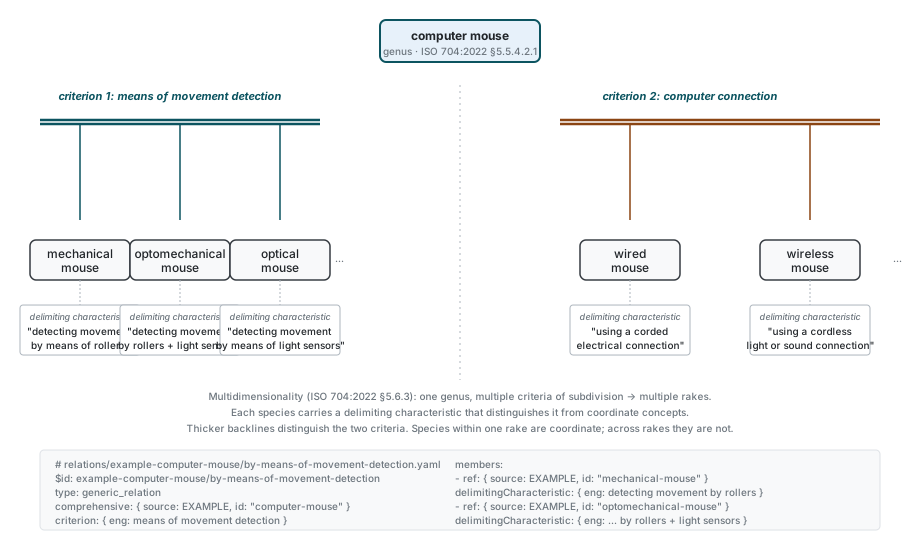
The thicker blue and brown backlines distinguish the two criteria. The characteristic rectangles carry the intension-difference that makes each species distinct within its rake.
The canonical ISO 704:2022 §5.5.4.2.2 example — optomechanical mouse (partitive)
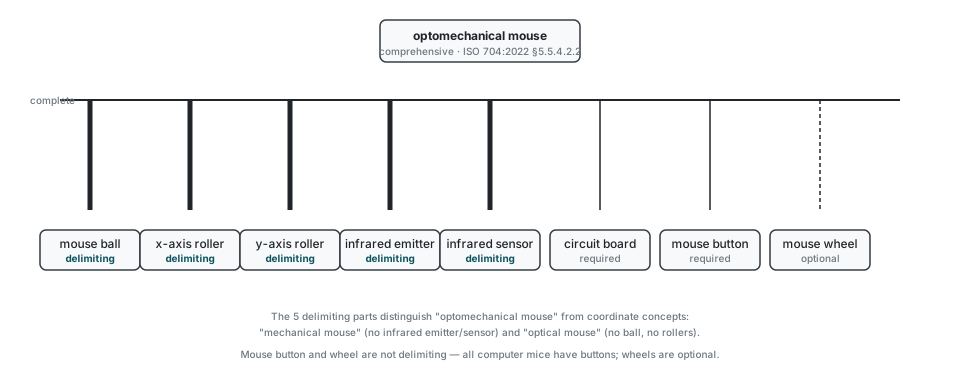
Distinct from §5.5.4.2.1 above. The optomechanical mouse is also used as the canonical partitive example — its parts (mouse ball, rollers, infrared emitter/sensor, etc.) are modeled as a PartitiveHyperedge. The five delimiting parts distinguish it from coordinate concepts (mechanical mouse, optical mouse):
Fictitious example — bicycle (partitive)
A bicycle decomposed by physical structure, exercising every MECE dimension:
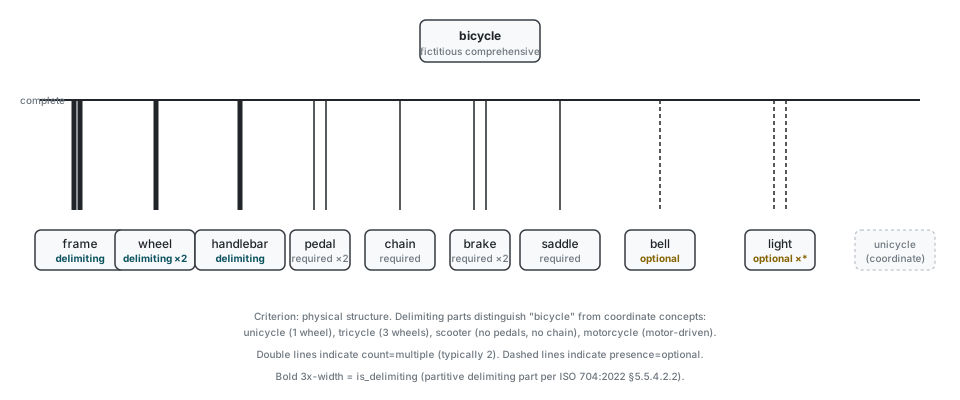
Bold lines = delimiting (frame, wheel, handlebar distinguish bicycle from unicycle/tricycle/scooter/motorcycle). Double solid lines = count: multiple (typically 2 wheels, 2 pedals, 2 brakes). Dashed = presence: optional (bell, light). Some optional parts combine both — optional + multiple (light: 0, 1, or 2+).
Fictitious example — vehicle (generic)
A vehicle genus with two distinct criterion groups — by motive power and by terrain:
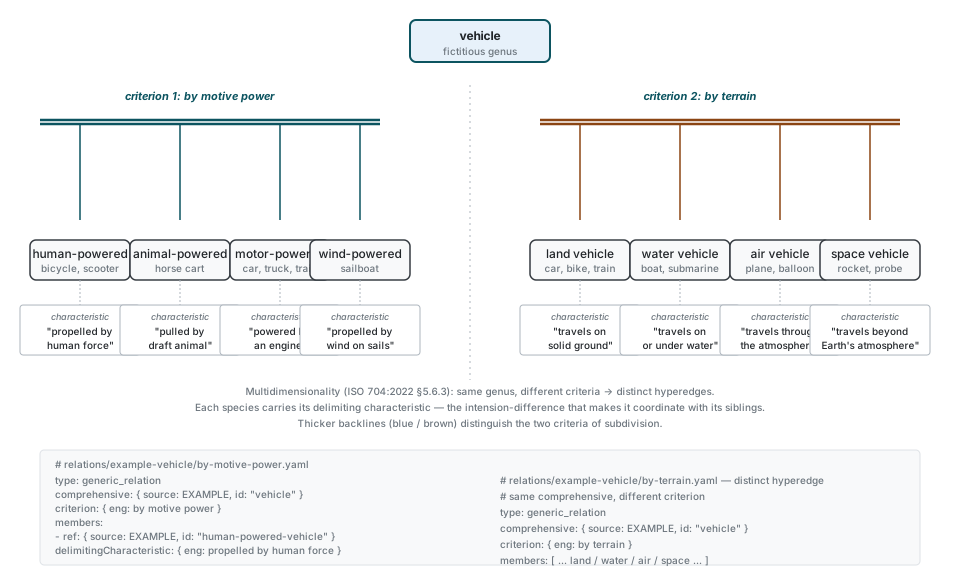
Each rake is a distinct hyperedge (distinct file under relations/example-vehicle/). Species within one rake are coordinate (bicycle and car share “vehicle” + “by motive power”); species across rakes are not (bicycle and boat share the genus but not a criterion).
How they work
MECE member multiplicity
ISO 704:2022 encodes per-member multiplicity via diagram line notation. Glossarist decomposes this into three independent axes (Mutually Exclusive, Collectively Exhaustive):
| Axis | Values | ISO 704 visual encoding |
|---|---|---|
| Presence | required | optional | Line style (solid vs dashed) |
| Count | exactly_one | at_least_one | multiple | Line count (1, 1+1, 2) |
| is_delimiting | true | false | Line weight (bold 3x vs normal) |
These three axes are independent — every combination is valid or explicitly rejected. There are 2 × 3 = 6 mathematically possible presence × count combos; 5 valid, 1 rejected.
The third axis (is_delimiting) is modeled differently per leaf class:
PartitiveMembercarriesis_delimiting: boolean(some parts delimit; ISO 704 §5.5.4.2.2)GenericMembercarriesdelimitingCharacteristic: LocalizedString(every species has one; ISO 704 §5.5.4.2.1)HyperedgeMember(abstract base) carries onlypresence×count— the shared MECE pair
The 5 valid + 1 invalid combinations
| UML | Glossarist model | ISO 704:2022 visual | ISO 704 name |
|---|---|---|---|
1..1 | required + exactly_one | 1 solid line | compulsory |
0..1 | optional + exactly_one | 1 dashed line | optional |
2..* | required + multiple | 2 solid lines | compulsory multiple |
0..* | optional + multiple | 2 dashed lines | optional multiple |
1..* | required + at_least_one | 1 solid + 1 dashed | compulsory at-least-one |
| — | optional + at_least_one | INVALID | — |
The invalid combination (optional + at_least_one) is rejected because if a member is optional (may be zero), the “at least one” constraint is vacuous — it collapses to (optional, multiple). Both the JSON Schema and the Ruby/JS validators reject it with a clear error message.
Why decompose instead of using a flat enum
A flat 5-value enum (compulsory, optional, compulsory_multiple, optional_multiple, compulsory_at_least_one) would express the same data. The MECE decomposition (2 + 3 = 5 values across 2 axes) is preferred because:
- DRY — adding a new count type (e.g.
zero_or_two) is one enum entry, not N×presence entries - MECE — every dimension is independent; no overlap
- OCP — validators, schema, and SHACL shapes each check one dimension independently
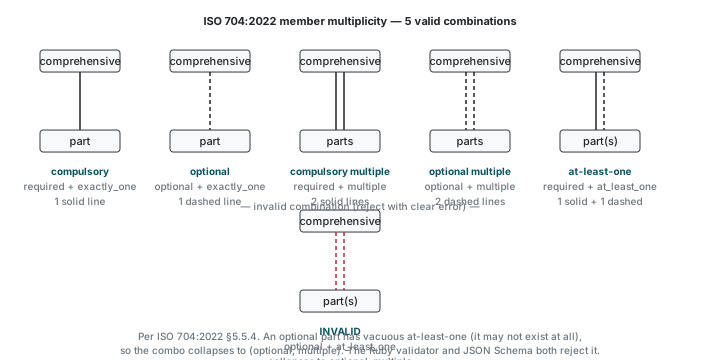
Six combinations mathematically possible; five valid. The invalid one (optional + at_least_one) collapses to optional + multiple because an optional part has vacuous at-least-one. Both the JSON Schema and the Ruby/JS validators reject it with a clear error message.
Coordinate-concept coherence (ISO 12620)
All members within one hyperedge are coordinate concepts — they share the comprehensive AND the criterion of subdivision. The coherence validator enforces:
- Each hyperedge has ≥2 members (ISO 704 “two or more”)
- No duplicate
(comprehensive, criterion)pairs — two hyperedges on the same comprehensive with the same criterion are duplicates (error) - Warns when a comprehensive has 2+ hyperedges and any lack criterion — distinctness can’t be verified
Criterion of subdivision
The criterion field is what makes members coordinate rather than incidentally co-decomposed. OIML V 2-200:2010 measurement standard has 6 criterion groups (by realization medium, by calibration role, by governance level, by metrological hierarchy, by reference/working, by travel) — each is a distinct hyperedge, each carries its own criterion.
Criterion is a localized string — it can carry text in multiple languages:
criterion:
  eng: by realization medium
  fra: par milieu de réalisation
  ara: بحسب وسط التحقيق
Per-file storage
Every hyperedge lives at:
relations/<comprehensive-id>/<criterion-slug>.yamlThe concept file no longer carries hyperedges inline. The directory IS the index — relations/viml-5-1/ enumerates every decomposition of concept 5.1.
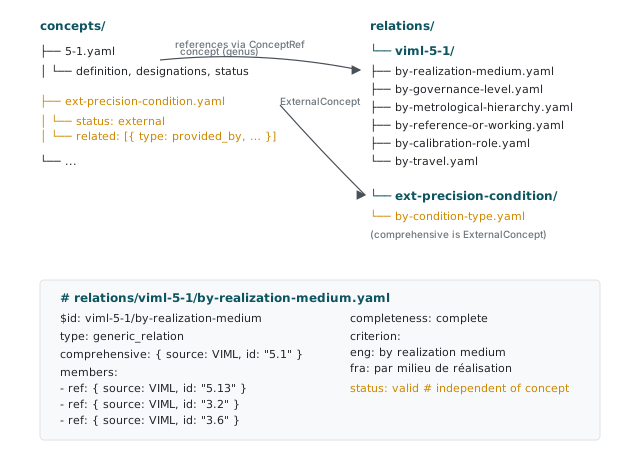
relations/<id>/.Reasons for the move:
- i18n bloat — a comprehensive with 6 hyperedges × 3 languages × (criterion + notes + sources’ modification) is ~60+ localized strings piled into the concept file
- Editing conflicts — terminologist restructuring a rake vs translator working on definition no longer collide
- Provenance — every hyperedge carries its own
sourcesandstatus, independent of the concept’s lifecycle - Multi-dataset addressability — the comprehensive can be in another dataset (ExternalConcept); per-file storage avoids editing “inside” a concept you don’t own
Binary related edges stay bundled in concept files — different scale, different lifecycle, different argument.
ExternalConcept as comprehensive
Some source diagrams use parenthetical/external concepts as the comprehensive — e.g. “(precision condition of measurement)” in OIML. Glossarist supports this natively:
# concepts/ext-precision-condition.yaml
id: ext-precision-condition
status: external
data:
  identifier: ext-precision-condition
  designations:
    - designation: "(precision condition of measurement)"
      type: expression
related:
  - type: provided_by
    ref: { source: urn:other-dataset, id: "precision-condition" }
# relations/ext-precision-condition/by-condition-type.yaml
$id: ext-precision-condition/by-condition-type
type: generic_relation
comprehensive:
source: EXAMPLE
id: ext-precision-condition
members:
- ref: { source: VIML, id: "2.20" }
- ref: { source: VIML, id: "2.22" }
- ref: { source: VIML, id: "2.24" }
completeness: complete
criterion: { eng: by precision level }The check-external-as-comprehensive validator warns when an ExternalConcept used as comprehensive has no provided_by edge — the decomposition dangles otherwise.
Model
AbstractHyperedge
  +comprehensive: ConceptRef [1]              # whole (partitive) or genus (generic)
  +members:       HyperedgeMember [2..*]      # parts or species
  +completeness:  Completeness [0..1]         # complete (default) | partial
  +criterion:     LocalizedString [0..1]      # ISO 12620 subdivision principle
  +sources:       ConceptSource [0..*]        # per-relation provenance
  +notes:         LocalizedString [0..1]      # optional commentary
  +status:        ConceptStatus [0..1]        # lifecycle (independent of comprehensive)

HyperedgeMember (abstract — shared MECE dimensions only)
  +ref:           ConceptRef [1]
  +presence:      Presence [0..1]             # required (default) | optional
  +count:         Count [0..1]                # exactly_one (default) | at_least_one | multiple

PartitiveMember extends HyperedgeMember
  +is_delimiting: Boolean [0..1]              # ISO 704 §5.5.4.2.2 delimiting part (default: false)

GenericMember extends HyperedgeMember
  +delimitingCharacteristic: LocalizedString [1]  # REQUIRED — ISO 704 §5.5.4.2.1 intension difference
The split is deliberate:
HyperedgeMembercarries only the shared MECE pair (presence×count). These are the dimensions every n-ary member has regardless of hyperedge type.PartitiveMemberaddsis_delimiting: boolean— a partitive-specific flag (ISO 704 §5.5.4.2.2) marking parts that behave like delimiting characteristics. Not all parts delimit, so the flag carries real information; rendered as the bold 3x-width line in source diagrams.GenericMemberaddsdelimitingCharacteristic: LocalizedString(required) — per ISO 704 §5.5.4.2.1, every species carries at least one delimiting characteristic (the intension-difference from coordinate concepts). Generic members don’t get a boolean flag — they get the text itself, because the text is the data.
Construction-time validation in glossarist-js enforces delimitingCharacteristic’s presence and non-emptiness on every GenericMember.
PartitiveHyperedge, GenericHyperedge, PartitiveMember, GenericMember are thin leaf classes that inherit the shared shape. Adding a fourth n-ary type later (e.g. SequentialHyperedge for ISO 12620 sequential concept systems) is one class addition — no validator or schema refactor.
Wire format
# relations/viml-5-1/by-realization-medium.yaml
$id: viml-5-1/by-realization-medium
type: generic_relation
status: valid
comprehensive:
  source: VIML
  id: "5.1"
members:
  - ref: { source: VIML, id: "5.13" }
    delimitingCharacteristic:
      eng: material sufficiently homogeneous and stable for a certified property
  - ref: { source: VIML, id: "3.2" }
    delimitingCharacteristic:
      eng: assembly of measuring instruments and auxiliary apparatus
  - ref: { source: VIML, id: "3.6" }
    delimitingCharacteristic:
      eng: device that reproduces a given quantity value during use
completeness: complete
criterion:
  eng: by realization medium
  fra: par milieu de réalisation
sources:
  - type: authoritative
    origin:
      ref: { source: OIML, id: "V 2-200:2010" }
      locality: { type: figure, reference_from: "5.1/Fig.1" }
The type field discriminates between partitive_relation and generic_relation on the wire.
::: info
Wire name vs. class name. The discriminator on the wire is
partitive_relation / generic_relation (retained for backward-compatibility
with the JSON Schema identifier). The in-code class name is
PartitiveHyperedge / GenericHyperedge. Same shape, two names — one for
the wire, one for the code.
:::
When to use a hyperedge vs. a binary edge
| Shape | Use when … |
|---|---|
Binary has_part / is_part_of | Pairwise part-of assertion with no multiplicity or completeness metadata |
Binary broader_generic / narrower_generic | Pairwise genus-species assertion |
PartitiveHyperedge | One-to-many part-of rake with multiplicity, delimiting parts, completeness, or subdivision criterion |
GenericHyperedge | One-to-many genus-species rake with criterion groups (e.g. OIML 5.1 has 6) |
ISO 704 requires two or more members per hyperedge. A single pairwise assertion should always be a binary edge, not a hyperedge.
Validators
Four Ruby validators enforce ISO 704 / ISO 12620 invariants:
check-partitive-relation-coherence— cardinality, duplicate criterion, MECE combo, delimiting+optional incoherence (partitive)check-generic-relation-coherence— same checks (generic)check-relation-file-shape—$idmatches file path; no bundled arrays in concept filescheck-external-as-comprehensive— ExternalConcept used as comprehensive must haveprovided_byedge
Shared logic lives in NaryCoherence — single source of truth across both hyperedge types.
See also
- Concepts — ManagedConcept, LocalizedConcept, ExternalConcept
- Relationships — binary typed edges
- ISO 704:2022 — Terminology work — Principles and methods
- ISO 12620 — Terminology and other content resources
- Relations-as-files design
- Abstract n-ary relation design