
Phase 1 ISO 704:2022 / 10241-1 / 12620 full coverage
After reading all three ISO standards end-to-end, Glossarist ships Phase 1 coverage: SequentialHyperedge, general/individual concept_type, AppellationDesignation for proper names, and definition-rule validators for ISO 704 §6.4. Closes concrete gaps surfaced by the full reading.
Earlier this week we shipped Hyperedges with the characteristic field per ISO 704:2022 §5.5.4.2.1. That closed one gap. Reading the three ISO standards end-to-end — ISO 704:2022, ISO 10241-1:2011, ISO 12620:1999 — surfaced five more concrete gaps. This post announces Phase 1 coverage closing all five.
What I’d been missing
Reading 704:2022 cover-to-cover made clear four things I’d under-modeled:
-
§5.2-5.3 — General vs individual concepts. ISO 704 is explicit: general concepts correspond to a category of objects (designated by terms), individual concepts correspond to a unique object (designated by proper names). I’d been treating all concepts uniformly. Proper-name terminology (Canada, UN, IBM, Statue of Liberty) couldn’t be modeled correctly.
-
§5.5.5 — Associative relation taxonomy. Table 1 enumerates 8 types × ~30 subtypes (contiguity, sequential, activity, instrumental, interactional, origination, transmission, opposite). I had ~5 enum values.
-
§5.5.4.3 + ISO 12620 A.6.3 — Sequential relations. ISO 12620 calls out sequential as a first-class relation type alongside generic and partitive. Manufacturing workflows, biological life cycles, software release lifecycles — all need ordered members, which Partitive and Generic don’t model. I’d been deferring this with “no evidence yet”; the evidence was everywhere.
-
§6.4 — Definition writing rules. Ten rules for intensional definitions: begin with a noun for nominal designations, no hidden definitions, no genus redefinition, reflect inheritance, single concept per definition. The substitution principle §6.4.4 is the canonical validity test. I had no validators for any of these.
Phase 1 — what shipped today
Five model additions + two new validators in concept-model PR #85:
1. SequentialHyperedge (ISO 12620 A.6.3)
Third n-ary hyperedge type alongside Partitive and Generic. Members are ordered — the array order matters (temporal, spatial, causal, developmental). Reversing the array reverses the sequence, a property Partitive and Generic don’t have.
Canonical example: the frog life cycle (ISO 704:2022 §5.5.5 developmental subtype).
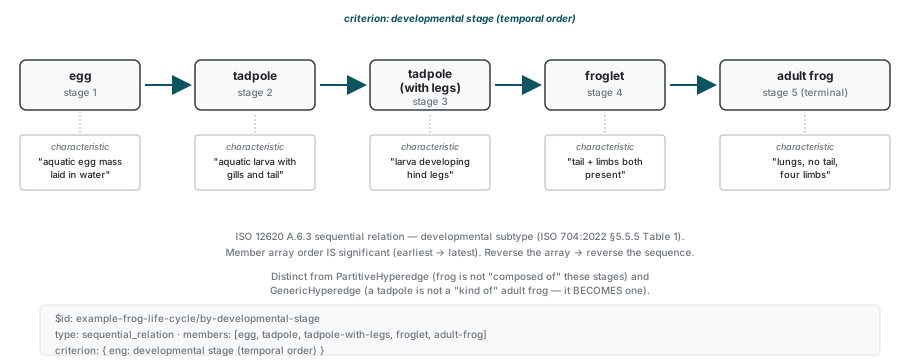
Use cases: manufacturing process steps, biological life cycles, software release lifecycles, supply chain stages, geological eras. Multidimensionality applies — same comprehensive, different sequencing criteria, distinct hyperedges.
See Sequential Relations for the full model reference.
2. concept_type: general | individual (ISO 704:2022 §5.2-5.3)
New top-level field on ManagedConcept. Defaults to general (most terminology work). Set to individual for proper-name terminology.
Individual concepts occupy the bottom rung of a concept ladder (§5.5.4.2.2) — they cannot be subdivided into more specific concepts. But they CAN be subdivided into parts via a partitive relation (§5.5.4.3.2) — “Canada” can be decomposed into provinces, counties, municipal units.
3. AppellationDesignation (ISO 10241-1:2011 §3.4.1.1.6, ISO 704:2022 §7.3.3)
New designation type for proper names. Distinct from ExpressionDesignation:
ExpressionDesignationdesignates general concepts (terms)AppellationDesignationdesignates individual concepts (proper names)
Concepts with concept_type: individual should use appellation; concepts with concept_type: general should use expression. The distinction matters for downstream tools (terminology extractors, NER, search) — knowing whether a designation is a term or a proper name changes the analysis.
4. check-sequential-relation-coherence validator
Mirror of partitive/generic coherence. Same cardinality, MECE, and duplicate-criterion checks. Plus a sequential-specific check: warns when a member ref appears more than once in the same sequence (suggests the sequence is poorly defined — “egg → tadpole → egg → adult” probably indicates an authoring error).
5. check-definition-rules validator
Applies ISO 704:2022 §6.4 definition writing rules:
- §6.4.3.2 — hidden definitions (heuristic: flags “which is a” / “that is a” patterns)
- §6.4.3.10 — intensional definitions of nominal designations should begin with a noun (heuristic: flags gerund openings)
- §6.4.5.2 — extensional definitions using generic relations should use “or” (
helium, neon, argon, ... or oganesson) - §6.4.5.3 — extensional definitions using partitive relations should use “and” (
helium, neon, ... and oganesson) - §6.4.4 — substitution principle reminder in output (cannot be auto-checked but is mentioned)
All warnings, not errors — these are heuristic checks. The substitution principle in particular requires human judgment: a definition is valid if it can replace the term in context without loss.
What’s deliberately NOT in Phase 1
Phase 2 (next)
- Associative relation taxonomy expansion — ISO 704:2022 Table 1’s full 8×30 type matrix. Additive to
RelatedConceptTypeenum. - Equivalence degree on localized concepts — ISO 704:2022 §7.7.3. Currently localized concepts are per-language with no equivalence-degree marker (full/partial/none).
- Homograph as designation-level relationship — ISO 10241-1 §3.4.1.4. Currently only at concept level.
- Systematic-order rendering — ISO 10241-1 §5.1 prefers systematic order (by concept system) over alphabetical. concept-browser could offer this as a view.
Phase 3 (longer, “make it big”)
ConceptSystemas first-class entity — ISO 12620 A.7 explicitly defines concept system types (generic / partitive / sequential / associative) and concept positions (broader / superordinate / subordinate / coordinate / related). I previously argued against promoting this from implicit to explicit; ISO 12620’s explicit treatment changes the calculus.- TBX (ISO 30042) import/export — universal terminology interchange format. Would unlock integration with every major termbank.
- Authoring workflow tool — Glossarist as a tool that walks terminologists through ISO 704:2022’s full methodology (identify concept field → identify objects → abstract to characteristics → form concepts → build concept systems → write definitions → form terms → establish equivalence).
- Generative AI integration — LLM-assisted definition drafting, characteristic extraction, equivalence checking.
- VS Code extension — live YAML validation, concept-ref autocomplete, definition substitution testing.
- Industry verticals — pre-packaged Glossarist profiles for medical (SNOMED integration), legal, engineering (ISO 80000 quantities + units), software (ISO/IEC vocabulary).
- Official ISO/TC 37 reference implementation — pursuing recognition as the canonical open-source terminology tool.
Lockstep rollout
This release is concept-model only. Companion PRs needed in:
- glossarist-ruby —
V3::SequentialHyperedge,V3::SequentialMember,V3::ConceptType,V3::AppellationDesignation; concept_type attribute on ManagedConcept; two new validation rules. - glossarist-js — mirror classes.
- concept-browser — render sequential hyperedges (with arrow notation, not rake teeth), individual-concept indicator, appellation styling.
- vocab datasets — populate
concept_typewhere known; identify sequential relations in OIML process descriptions.
Further reading
- Hyperedges — unified model page
- Sequential Relations — new model page
- Concepts — updated with general vs individual distinction
- ISO 704:2022 — Terminology work — Principles and methods
- ISO 10241-1:2011 — Terminological entries in standards
- ISO 12620:1999 — Computer applications in terminology — Data categories