
The Glossarist Concept Model
A self-contained information model for terminology management, aligned with ISO 10241-1, 704, 30042, 12620, and 25964 — designed to handle everything from simple glossaries to complex multilingual concept systems, with interoperability across multiple technology ecosystems.
How concepts work
Every Glossarist concept is a ManagedConcept — a language-independent entity that groups per-language LocalizedConcept instances. Each localization carries its own definitions, designations, notes, examples, and source references.
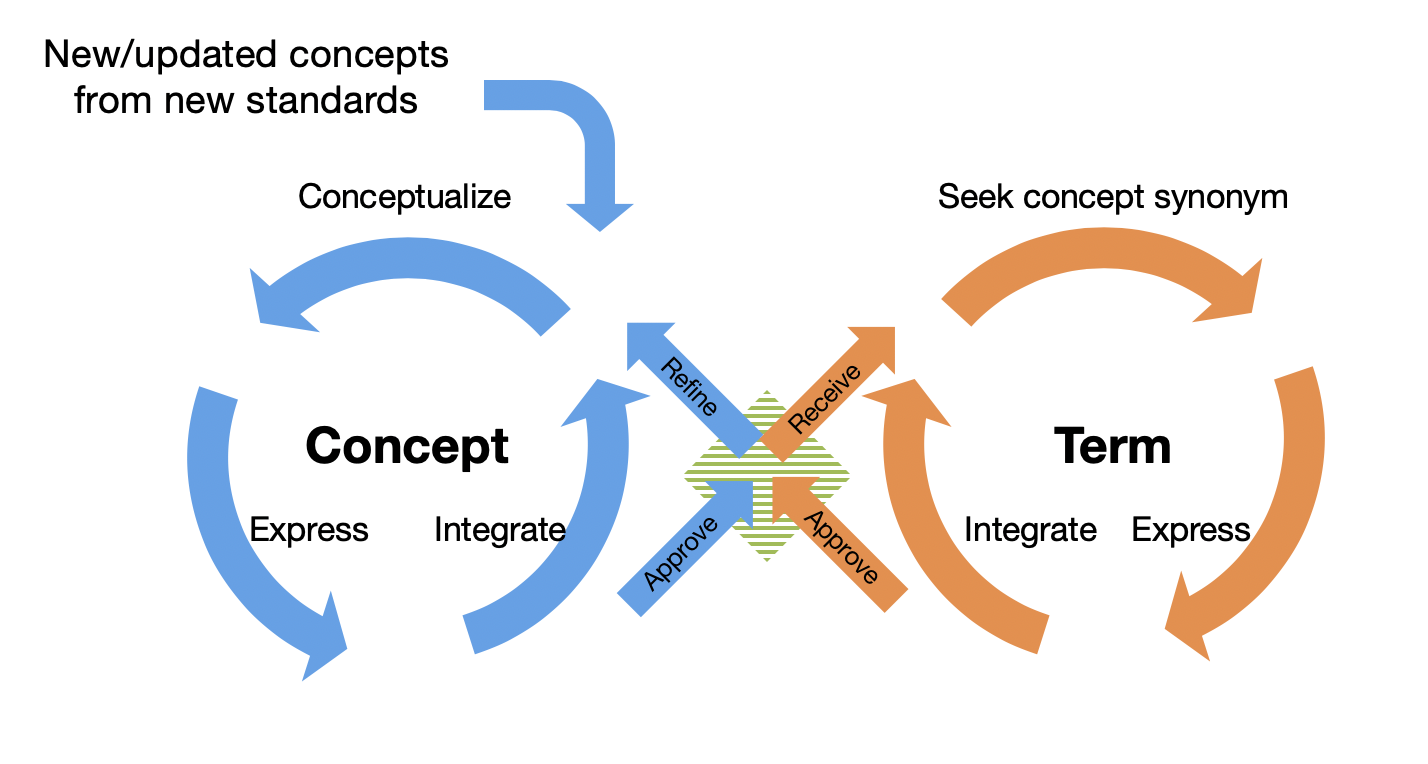
The model separates what a concept is (its identity, lifecycle, relationships) from how it is expressed (terms, abbreviations, symbols in different languages). This separation lets you maintain concept-level relationships (broader, narrower, equivalent) independently of language-specific terminology.
Authoring concepts in YAML
Concepts are authored in structured YAML files. The V3 schema consolidates all localizations into a single file per concept:
# concepts/3.1.1.1.yaml
termid: "3.1.1.1"
termid_uuid: "a1b2c3d4-..."
status: valid
tags: [geometry, foundational]

eng:
  terms:
    - type: expression
      designation: "entity"
      normative_status: preferred
  definition:
    - content: "A concrete or abstract thing that exists, has existed, or can exist"
      examples:
        - content: "A bank account, a transaction, a customer"
      notes:
        - content: "Includes objects, concepts, and relationships"
  sources:
    - type: authoritative
      origin: "ISO 19107:2003, 4.5"
      status: identical

fra:
  terms:
    - type: expression
      designation: "entité"
      normative_status: preferred
  definition:
    - content: "chose concrète ou abstraite qui existe, a existé ou peut exister"
  sources:
    - type: authoritative
      origin: "ISO 19107:2003, 4.5"
      status: identical
See the YAML Schema Reference for complete field documentation and enum values, or the Entity Field Reference for per-entity field lists with types and cardinality.
What’s new in v3.1
The v3.1.0 release (July 2026) extends the concept model with dataset-aware structure and non-verbal entities. It is a fully additive release — no existing URI was renamed.
| Addition | What it adds |
|---|---|
| Dataset register & sections | Self-describing datasets with hierarchical sections, transitive membership, and ordering method (systematic / mixed / alphabetical) |
| Non-verbal entities | Dataset-level Figure, Table, Formula with localized captions, alt text, image variants, and subfigures |
| Designation relationships | First-class DesignationRelationship class for designation-level links (e.g. abbreviated_form_for) |
| Scoped examples | examples on DetailedDefinition for VIM 1993-style nested examples (MECE with concept-level examples) |
| Annotations | Editorial annotations field on LocalizedConcept, distinct from notes |
| Inline mentions | ConceptSource#id enables cite mentions in running text; fig mentions for figures (see Sources) |
| Tags | Free-form tags array on concepts for grouping and filtering (distinct from terminological domains) |
| 52 relationship types | MECE coverage of ISO 10241-1, ISO 19135, ISO 25964, SKOS, ISO 12620, and TBX |
| Canonical prefixes | ontologies/prefixes.ttl is the single source of truth for prefix bindings (skosxl: is canonical) |
| 2 new SKOS taxonomies | ordering-method and concept-reference-type — bringing the total to 16 taxonomies |
Standards alignment
Every entity in the Glossarist model maps to established international standards:
| Standard | Role in Glossarist |
|---|---|
| ISO 10241-1 | Terminology entries in standardized vocabularies — concept structure, designations, sources |
| ISO 704 | Principles and methods — concept systems, definitions, term formation rules |
| ISO 30042 / TBX | Terminology markup framework — data exchange format |
| ISO 12620 | Data category registry — term type classifications |
| ISO 25964 | Thesauri — hierarchical and mapping relationships (BTG/NTG, BTP/NTP, BTI/NTI) |
| OWL 2 / SHACL | Formal model definition — the concept model is expressed as an OWL ontology with SHACL shapes for validation and Semantic Web interoperability |
| SKOS / SKOS-XL | Knowledge organization — concept schemes and reified labels for linked data mapping |
Processing with code
JavaScript (glossarist-js)
import { loadGcr, readConcepts } from 'glossarist';

const concepts = readConcepts('./geolexica-v2/');
concepts.forEach(c => {
  console.log(c.id, c.primaryDesignation('eng'));
});
Ruby (glossarist-ruby)
require 'glossarist'

collection = Glossarist::ManagedConceptCollection.new
collection.load_from_files('./concepts/')

concept = collection['3.1.1.1']
puts concept.localizations['eng'].definition
Reference sections
- Concepts — ManagedConcept, LocalizedConcept, concept lifecycle, collections
- Designations — Designation type hierarchy, pronunciation, base properties
- Relationships — Typed relationship kinds across 4 standards
- Sources — Authoritative source hierarchy and provenance
- Datasets & sections — DatasetRegister, hierarchical sections, ordering, bibliography
- Non-verbal entities — Figure, Table, Formula as dataset-level resources
- Term Types — ISO 12620 term type classifications
- YAML Schemas — V2 and V3 schema overview and examples
- YAML Schema Browser — Interactive JSON Schema definitions
- Entity Field Reference — Per-entity field reference with types and cardinality
- Ontology Browser — Interactive OWL ontology and SHACL shape browser
Core entities
ManagedConcept
The top-level entity. Holds a UUID, lifecycle status, domain references, and maps language codes to LocalizedConcept instances.
statuslocalized_conceptsrelateddomainsdatesLocalizedConcept
Per-language realization of a concept. Each language gets its own definition, designations, notes, examples, and classification.
designationsdefinitionnotesexampleslanguage_codeDesignations
Designation types in a MECE hierarchy — expressions, abbreviations, symbols (letter and graphical), prefixes, and suffixes.
expressionabbreviationsymbolletter_symbolgraphical_symbolprefixsuffixRelationships
Typed semantic links spanning 4 ISO standards — hierarchical, partitive, associative, equivalence, mapping, and spatiotemporal.
broader/narrowergeneric/partitiveexact_matchdeprecatesand moreSources
Multi-level provenance tracking — authoritative and lineage sources with status tracking (identical, modified, restyled, generalisation).
authoritativelineagestatusoriginmodificationFormal Ontology
The concept model is formally expressed as an OWL ontology with SHACL validation shapes. Interoperates with SKOS, SKOS-XL, ISO 25964, PROV-O, and Dublin Core for linked data integration.
owl:Classsh:Shapeskos:Conceptskosxl:Label