
Concepts
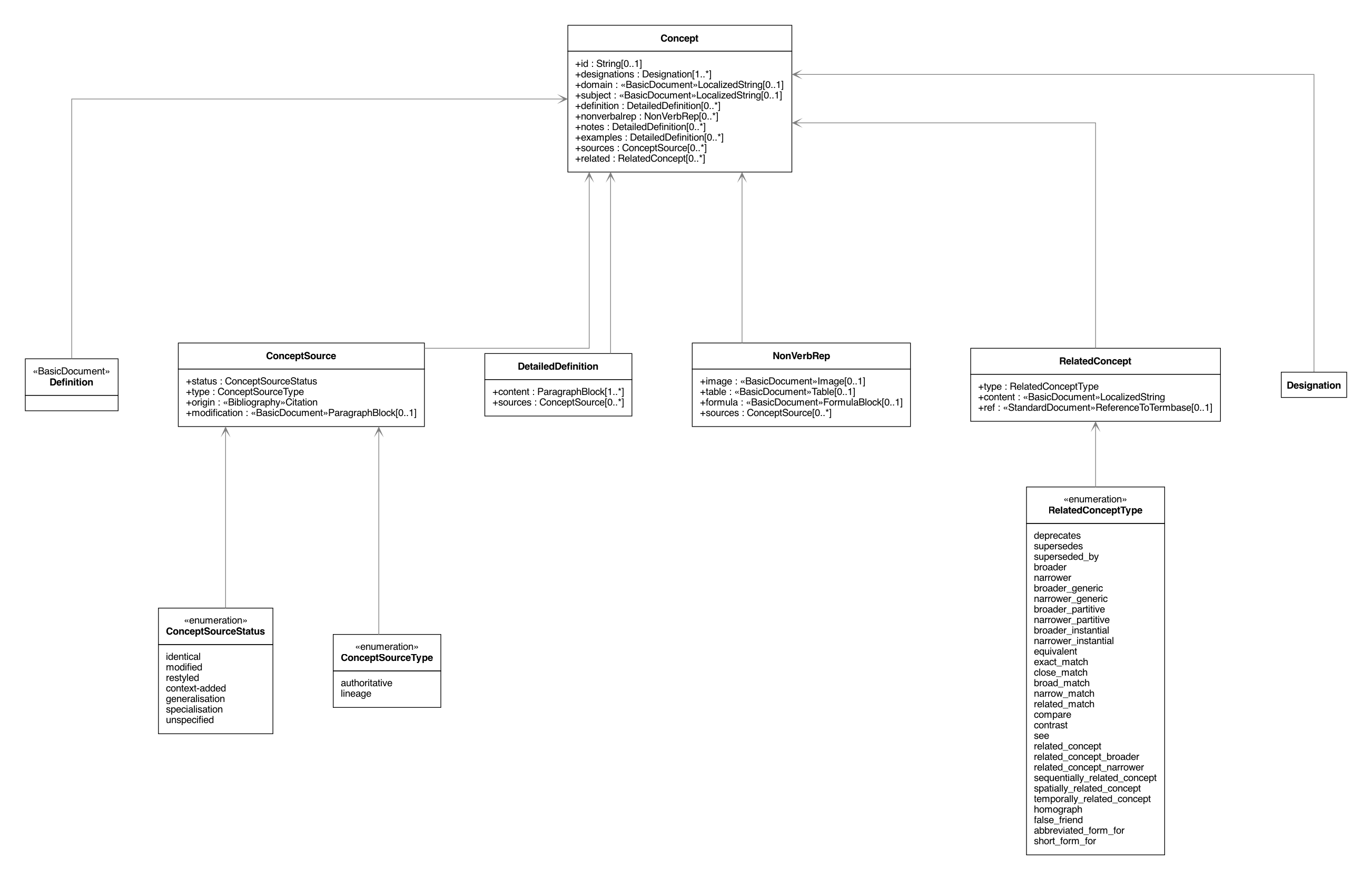
ManagedConcept
A ManagedConcept is the top-level concept entity in Glossarist. It represents a single concept in the terminology registry. See the ManagedConcept entity definition for the authoritative field list.
| Field | Type | Card. | Description |
|---|---|---|---|
identifier | string | 1..1 | String identifier for the concept |
uri | anyURI | 0..1 | URI for the concept |
status | conceptStatus | 0..1 | Lifecycle status |
related | RelatedConcept[] | 0..* | Related concepts |
dates | ConceptDate[] | 0..* | Governance events |
sources | ConceptSource[] | 0..* | Concept-level sources |
domains | Reference[] | 0..* | Subject area references (rendered as <domain>) |
tags | string[] | 0..* | Organizational tags for grouping and filtering (not rendered as terminological domains) |
localizations | LocalizedConcept{} | 0..* | Per-language data (keyed by language code) |
Tags vs domains
tags and domains look similar but serve different purposes:
domains— Terminological subject-area references. Rendered as<domain>elements in TBX output and surfaced as subject-area classifications in the concept-browser.tags— Free-form organizational labels used for filtering, document structuring, and retrieval. Not rendered in terminological output.
termid: "3.1.1.1"
status: valid
domains:
  - { concept_id: "103", ref_type: "domain" }
tags: [time-scale-units, foundational]
LocalizedConcept
Localizations of the concept to different languages. Each language has its own definition, notes, examples, terms, and revision history. See the LocalizedConcept entity definition for the authoritative field list.
| Field | Type | Card. | Description |
|---|---|---|---|
language | string | 0..1 | ISO 639 3-letter language code |
script | string | 0..1 | ISO 15924 4-letter script code |
system | string | 0..1 | ISO 24229 conversion system code |
designations | Designation[] | 0..* | Terms under which the concept is known |
definition | DetailedDefinition[] | 0..* | Definitions |
notes | DetailedDefinition[] | 0..* | Notes |
annotations | DetailedDefinition[] | 0..* | Editorial annotations (distinct from notes) |
examples | DetailedDefinition[] | 0..* | Concept-level examples |
entry_status | entryStatus | 0..1 | notValid, valid, superseded, or retired |
classification | string | 0..1 | preferred, admitted, or deprecated |
domain | anyURI | 0..1 | URI reference to the subject area |
related | RelatedConcept[] | 0..* | Per-language concept relationships |
sources | ConceptSource[] | 0..* | Per-language sources |
references | Reference[] | 0..* | Typed references |
dates | ConceptDate[] | 0..* | Per-language governance events |
release | string | 0..1 | Release version |
review_type | string | 0..1 | editorial or substantive |
lineage_similarity | integer | 0..1 | Lineage similarity score |
DetailedDefinition
A definition, note, example, or annotation with optional per-item sources and scoped sub-examples.
| Field | Type | Card. | Description |
|---|---|---|---|
content | string | 1..1 | The text content |
sources | ConceptSource[] | 0..* | Per-item sources |
examples | DetailedDefinition[] | 0..* | Examples scoped to this entry (VIM 1993 style nesting) |
Scoped examples (VIM 1993 style)
Some vocabularies — notably the ISO/IEC VIM (International Vocabulary of Metrology) — nest examples inside the note or definition they elaborate on, rather than at the concept top level. Glossarist models this with examples on DetailedDefinition.
The two examples fields are MECE (mutually exclusive, collectively exhaustive):
LocalizedConcept.examples— concept-level examples, rendered as a flat listDetailedDefinition.examples— scoped to the surrounding note/definition
eng:
  definition:
    - content: "A property of a phenomenon, body, or substance"
      notes:
        - content: "Notes can themselves have examples"
          examples:
            - content: "Mass, weight, and volume are quantities"
      examples:
        - content: "Concept-level example, rendered as a flat list"
ConceptDate
A governance event in the concept lifecycle.
| Field | Type | Card. | Description |
|---|---|---|---|
date | dateTime | 1..1 | Date and time of the event |
type | dateType | 1..1 | Event type (accepted, amended, retired, review, reviewDecision) |
description | string | 0..1 | Event description |
Concept lifecycle
Concepts follow a lifecycle through these statuses:
- draft — Initial proposed state
- submitted — Change request submitted for review
- valid — Accepted and current
- superseded — Replaced by a newer concept
- retired — No longer in use
Multi-language localization
A single ManagedConcept can have localizations in any number of languages. Different languages may assign the same abstract concept to different domains, and concept hierarchies can differ across languages.
ManagedConceptCollection
A collection for managed concepts. Includes the Ruby Enumerable module. Supports loading from and saving to YAML file datasets.
See the YAML Schema Reference for the complete JSON Schema definitions, the Entity Field Reference for all entity types with types, cardinality, and allowed values, and the Standards compliance reference for how each ISO standard maps to Glossarist entities.